

Crates, pallets and bins
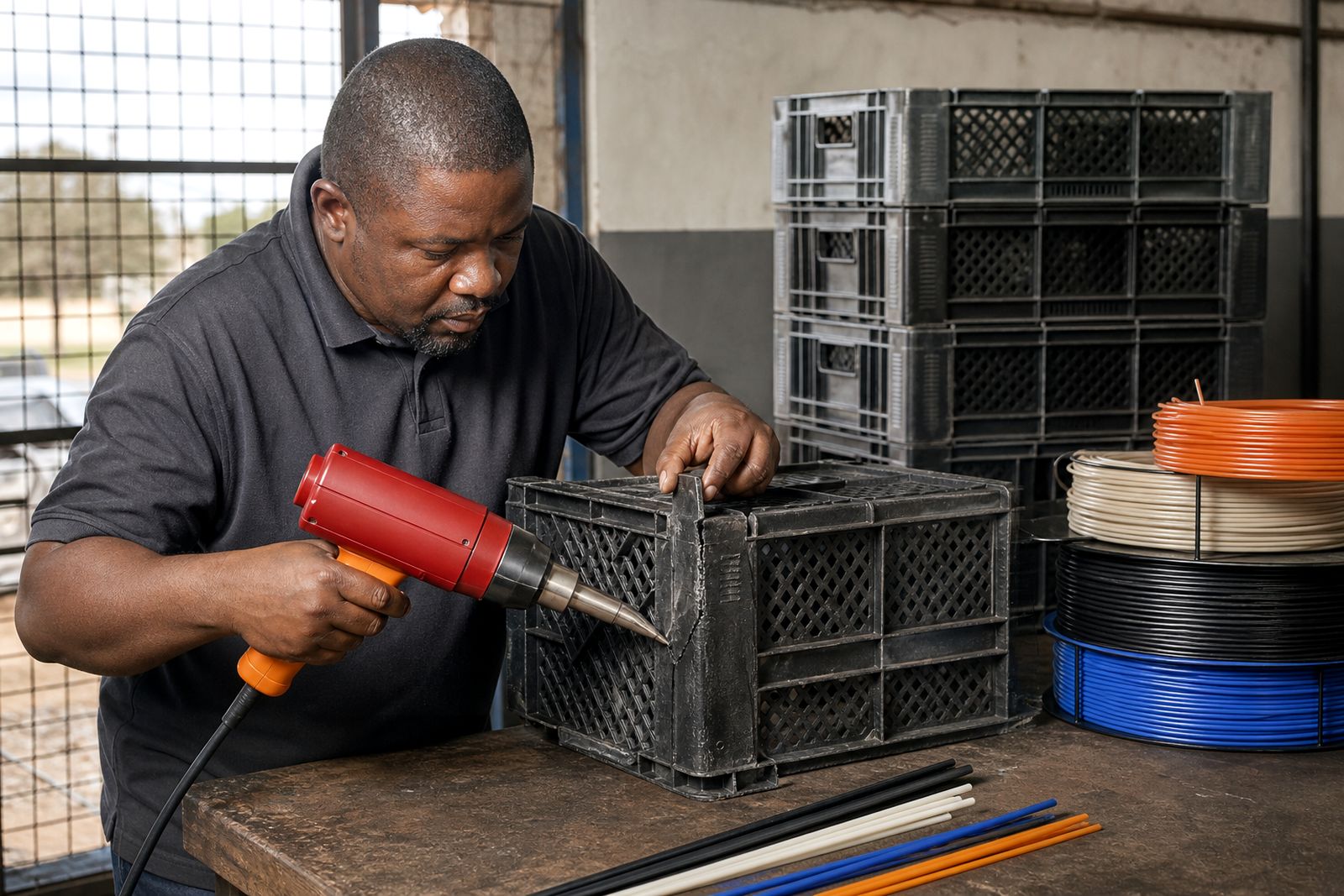
Plastic crates, pallets and bins take repeated knocks, flexing and abrasion, so small cracks can spread fast once the load cycle starts. Good plastic welding can keep useful handling gear in service, provided the base material is identified properly and the repair is shaped for the job it returns to.
Where these repairs fail first
Handling gear does not usually break in the middle of a flat panel for no reason. Damage starts around corners, hand grips, fork entry points, base ribs and hinge areas where stress keeps concentrating through daily loading and stacking. On many crate and bin jobs the visible split is only part of the problem, because the surrounding area has gone chalky, thinned out or been rubbed away by repeated contact.
In South African yards and stores, sunlight, wash chemicals and rough concrete all add to the wear pattern. A fish box near the coast can go brittle sooner than a dry indoor tote on the East Rand, while a pallet used in a cold room may crack at impact points after being dropped with a partial load. The repair method must match that real use case, not only the shape of the crack.
- Corner cracks often need the stress carried past the visible split.
- Base rib fractures usually need a rebuild of shape as well as a weld.
- Forklift strike damage can leave hidden tearing beside the main opening.
- Stacking bins may fail around lips where the weight sits repeatedly.
Material ID matters more than people think
One of the main reasons a repair peels away later is that the wrong rod was used from the start. Crates, pallets and bins are commonly moulded from PP, PE or HDPE, but mixed parts and additives can change the way the surface behaves under heat. Some pieces are marked clearly, others are not, and old industrial handling gear can be dirty enough to hide the moulded code.
Before welding, the workshop should identify the plastic as closely as possible and choose a matching rod profile. Round rod can suit some groove fills, while triangular rod is useful where a shaped channel has been cut and the operator wants a neat build-up with controlled feed. A good match improves bond strength and makes the finished weld less likely to tear at the edge.
- PP is common on reusable crates and many stackable bins.
- PE and HDPE are widely found on heavier bins, lids and chemical containers.
- A rod that is close in colour is helpful, but polymer match matters more.
- Unknown plastic should be tested carefully before a production batch is touched.
We help customers work through material identification and rod selection, especially when a workshop is setting up this repair work for the first time.
Prep work decides whether the weld holds
Plastic welding on handling gear is not just a matter of blowing hot air at a split. Dirt, grease, label residue and ingrained dust all interfere with the weld area, and crates that have carried produce, powders or workshop parts often need more cleaning than expected. If contamination is left in the joint, the bead can look acceptable on top while the root remains weak.
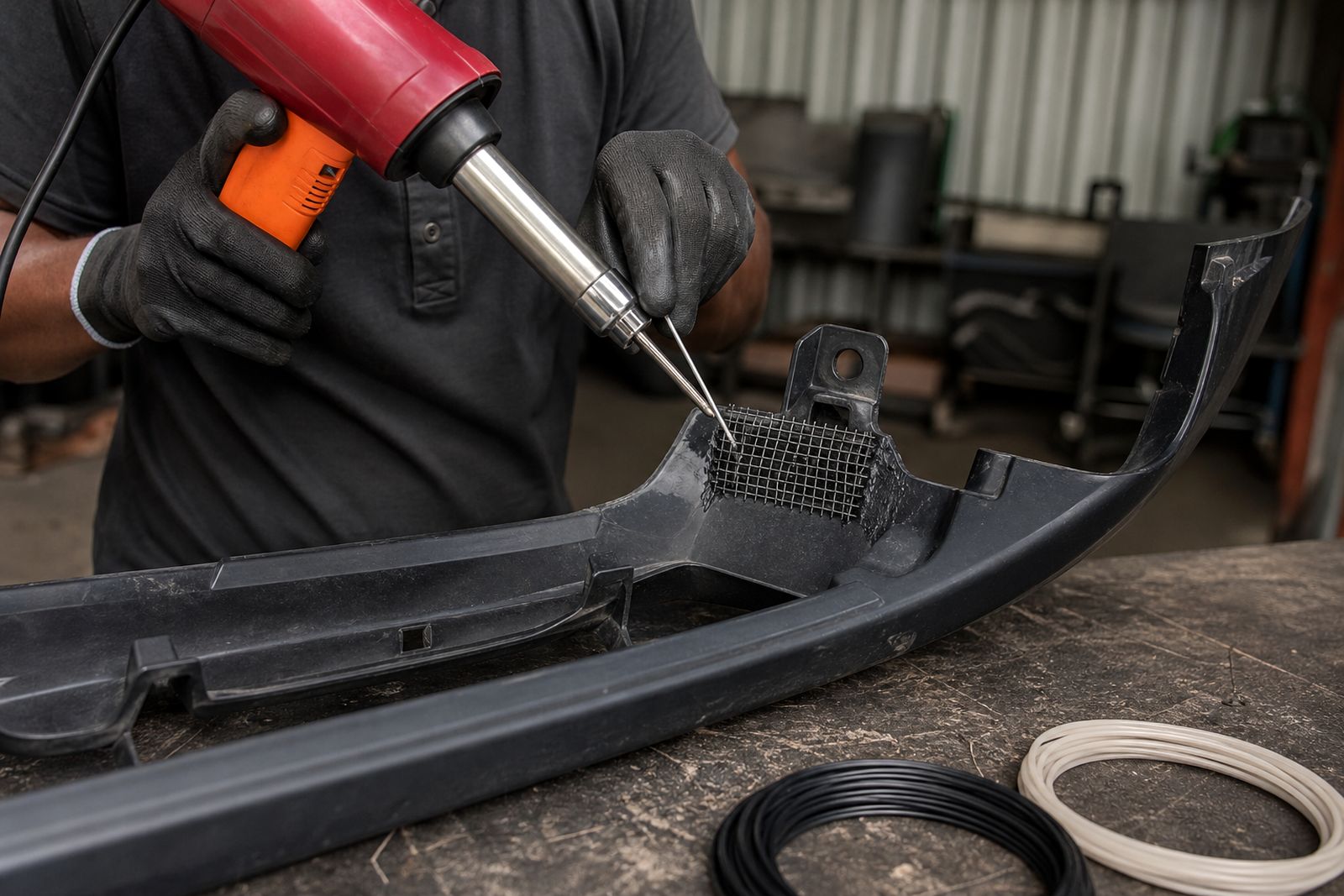
A sound routine starts with cleaning, trimming loose edges and stopping the crack from running further. The damaged area is then opened into a controlled groove so fresh material can be laid into the joint rather than merely bridging over it. Where the wall has worn thin, stainless reinforcing mesh can help support the repair, but it should not be treated as a shortcut for poor preparation.
Operators also need to support the part correctly. A floppy side wall or twisted base can move while hot and set in the wrong position, which leaves the bin rocking on the floor or the crate refusing to stack square. That sort of distortion is avoidable, but it needs attention before heat goes on, not after.
A workshop example from the East Rand
A panel shop and general repair workshop in Germiston brought in a batch of stackable plastic bins used for loose components. Most had split at the upper rim where the bins were being lifted while still overloaded. A few had star cracks near the base corners from being shoved across concrete rather than carried. The workshop wanted a repeatable method it could handle in-house, because replacing every damaged bin was costing more than the labour to repair them.
After sorting the bins by material and crack type, the team used matching rod on the rim failures and rebuilt the worn base corners in layers. The useful lesson was not only the welding itself, but the separation of jobs into groups. Thin rim cracks needed careful heat control and good alignment, while the corner rebuilds needed more preparation and a wider reinforcement area. Once the operators saw the difference, the work became more consistent and less wasteful, even the second day looked tidier.
That is typical of this kind of job. The gain comes from method and material control, not from rushing through a pile of damaged parts with one setting and one rod.
Tools and consumables that make these jobs easier
For crate, pallet and bin repairs, a practical setup usually includes a hot-air welding gun, the right nozzles, matching rod, trimming tools and some form of reinforcement for selected areas. The best nozzle depends on whether the operator is tacking, speed welding or working around an awkward rib and corner. A broad approach rarely gives the cleanest result on moulded handling gear because shapes change quickly over a short distance.
- Speed welding nozzles suit longer runs where rod feed needs to stay controlled.
- Tacking nozzles help position edges before the final pass is laid.
- Scrapers are useful for cleaning and dressing the weld area.
- Reinforcing mesh can assist on stressed zones when used with care.
- Starter kits are handy for workshops adding plastic repair to existing work.
Training matters as much as the tool list. Operators need to recognise overheating, poor rod feed, contaminated joints and weak tie-in at the bead edges. Those faults are easy to miss when the part looks acceptable straight off the bench.
When to repair, and when to retire the part
Not every pallet or bin deserves a weld. If the plastic has become brittle across a wide area, or if too many previous repairs have left the structure warped and hard to stack, retirement may be the sensible call. The point of a repair is to return useful service, not to patch around a part that has already reached the end of its working life.
On the other hand, many damaged items are very repairable when the crack is localised and the material is still sound. A well-prepared weld on a crate side, a bin lip or a pallet rib can extend service in a very practical way. Workshops that handle repeated damage patterns often benefit from holding the common rods, nozzles and consumables on hand and giving one or two operators proper instruction rather than leaving the work to guesswork.
Plasti-Weld supplies rods, hot-air guns, nozzles, accessories and starter kits for this kind of work, and we run practical training for teams that want to tackle repairs properly in their own workshop. We do not take in public repair jobs, but we do help customers match the plastic and select suitable welding gear.
What our Plastic Welding customers say
Verified Google reviews
Questions we get asked
Can cracked plastic crates be welded more than once?
They can, if the surrounding plastic is still sound and the earlier weld has not left the area badly distorted or brittle. Repeated failures in the same zone usually point to load pattern, handling method or incorrect rod choice.
Which rods are commonly used on bins and pallets?
PP, PE and HDPE rods are common on handling gear, with the final choice depending on the moulded material of the part. Matching the polymer matters more than matching the colour.
Do you repair crates and bins for the public?
No. We supply plastic welding rods, hot-air guns, accessories, starter kits and training so workshops, fabricators and DIY users can handle suitable repair work themselves.
Tell us about the job
Send sizes, materials and where you are through our contact form, and we will come back with the practical options.
Open the contact form