

Automotive plastic repair
Modern vehicle plastics can often be repaired neatly if the parent material is identified properly and the weld is built with the right rod, nozzle and prep. This guide looks at bumpers, tabs, grilles and trim from a workshop point of view, with local conditions that matter on South African roads.
Not every cracked bumper needs replacement
Many automotive plastic parts fail at stress points rather than across the whole component. A parking knock may split a bumper skin near a mounting point, while vibration can break a light tab or grille clip long before the rest of the panel is worn out. In those cases, plastic welding can return strength and shape without sending the whole part to scrap.
The key is to repair material with material. Adhesives can hold for light cosmetic work, but where a part flexes, carries clips, or lives close to road spray and engine heat, a matched welding rod usually gives a better base for shaping and finishing. That matters on vehicles that spend long hours in the sun, pick up stone strikes on the freeway, or work on gravel routes around the East Rand, the Vaal and further inland.
- Bumpers with splits, tears and torn mounting zones.
- Headlamp and grille tabs that break off at a narrow neck.
- Wheel arch trims and valance pieces with localised damage.
- Plastic undertrays, ducting and guards where the base material is still present.
Where chunks are missing entirely, or the plastic has gone brittle over a wide area, a workshop should assess honestly whether welding is still sensible. The process works best when there is enough sound parent plastic to support the repair and hold alignment during welding.
Match the rod to the plastic first
A good looking weld can still fail quickly if the rod does not match the part. Automotive repair work often involves PP, PP/EPDM, PE and ABS, with PVC appearing on some older or non-structural items. Bumpers are commonly polypropylene based, but that is not universal, so the repair starts with identification rather than guesswork.
Most vehicle plastics have a moulded identification mark on the reverse side. If the panel is off the vehicle, that mark can save time and wasted rod. If there is no clear stamp, the technician needs to look at the part type, surface feel, flexibility and how it behaves under controlled heat. This is where many DIY attempts go wrong, the crack is welded with the first rod at hand and the join peels open during sanding or refitting.
- PP and PP/EPDM are common on bumper skins and trims.
- ABS is often found on rigid moulded parts and some housings.
- PE appears on certain liners, reservoirs and guards.
- Rod profile matters too, with round and triangular rod used for different groove shapes and bead control.
Plasti-Weld helps customers identify the plastic and pair it with a suitable rod, especially where a panel shop has an unusual part on the bench and wants to avoid a poor match. That step costs less than redoing the work later.
Prep work decides whether the repair holds
Automotive plastics pick up wax, polish, silicone dressing, tar and road film. If that contamination stays in the weld zone, the bead will look dull, foam up, or separate at the edges. Clean back well, open the crack properly and remove paint from the repair area before heat goes anywhere near the part.
For a split bumper, many workshops tack from the back first to lock alignment, then cut a V-groove on the face and rear where access allows. Broken tabs often need a small jig or temporary clamping so that the tab sits exactly where the lamp, grille or bracket expects it. A millimetre out can make refitment a nuisance.
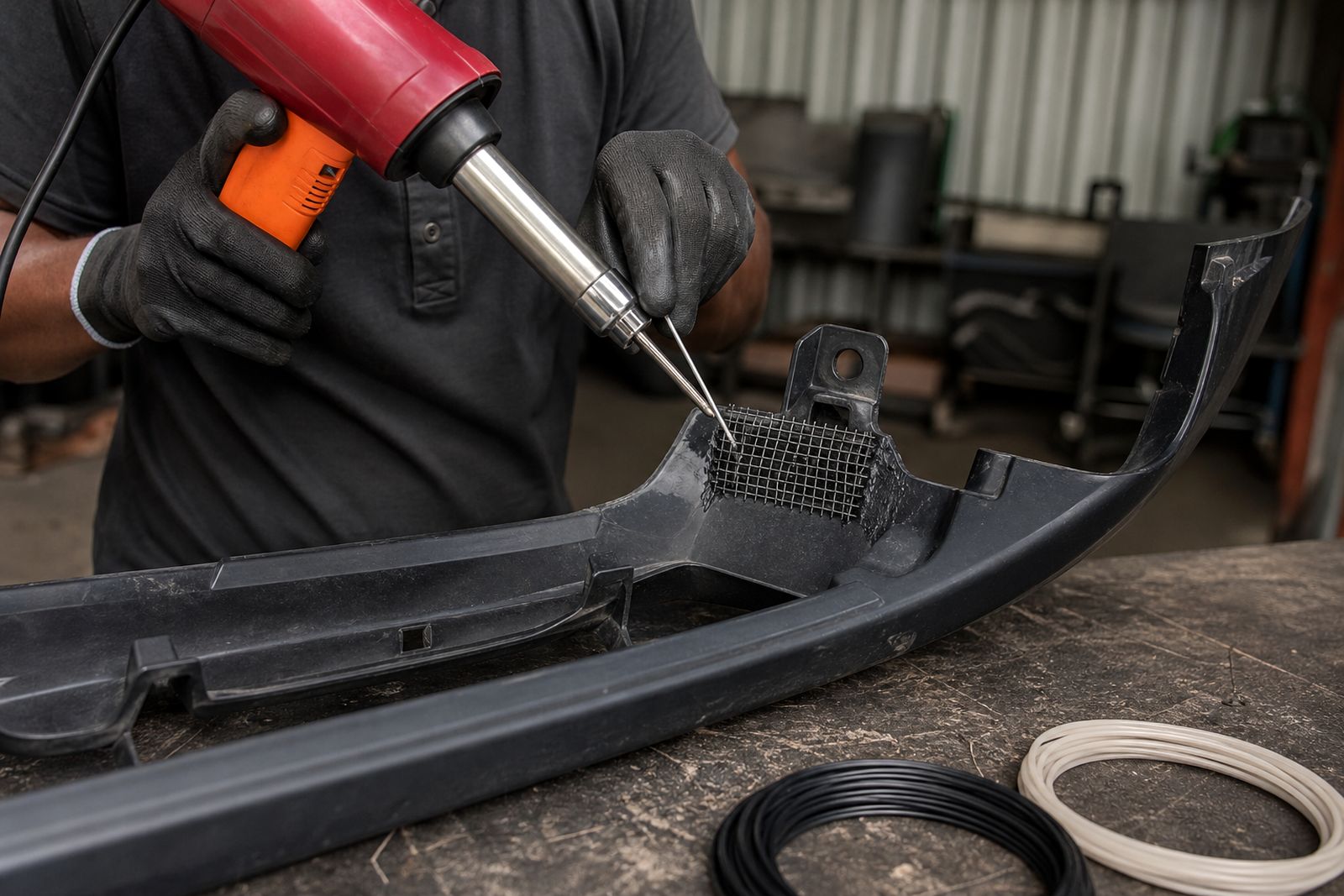
Reinforcing mesh can help on the rear of some repairs, especially around tabs or mounting zones where load is concentrated. It should support the weld, not replace it. Mesh buried into mismatched plastic will not fix a weak bond.
- Clean away dressings, polish residue and road grime.
- Strip coatings back to clean parent plastic.
- Stop-drill a running crack where suitable before grooving.
- Tack the part in position before laying a full bead.
- Use mesh selectively on the reverse side for stressed areas.
On thin grille bars and narrow trim pieces, less heat is often better. It is easy to sag an edge or print a nozzle mark into a visible face if the operator rushes the warm-up.
A practical workshop example from the East Rand
A panel shop in Germiston received a work bakkie with a torn front bumper corner, two broken grille tabs and a lower trim piece dragging on one side. The bumper had not shattered, but the mounting area had stretched and split after a low speed impact with a tow hitch. Replacement parts were available only as separate imported items, which would have left the vehicle standing longer than the workshop liked.
The team removed the bumper skin and checked the plastic mark on the inside. Once the material was confirmed, they aligned the tear, tacked it from behind and welded both sides with matched rod. The damaged tab bases were rebuilt with short sections of rod and supported on the rear with stainless mesh where the clips would carry load. The lower trim needed less filler than expected, just careful grooving and bead control to restore the edge without a lumpy finish.
Because the vehicle worked outdoors, the shop paid attention to flexibility rather than making the repair overly hard with excess material. After cooling, they trimmed and shaped the bead, test fitted the panel, and only then moved to normal refinishing steps. The result was a repair that sat correctly on the vehicle and handled refit stress without cracking open at the first clip point. It was not fancy work, just proper prep and the right rod.
Common mistakes on tabs, grilles and trim
Small components can be trickier than big cracks. A narrow grille rib or mirror trim edge loses shape quickly when overheated, and tiny tabs often fail because the repair becomes bulky instead of accurate. The part may be technically joined but still unusable when the screw hole, clip slot or lamp line no longer matches.
- Using too much air and scorching the surrounding plastic.
- Trying to bridge dirt, paint or chrome finish instead of removing it.
- Choosing a rod by colour rather than by polymer type.
- Building a tab without checking the exact bracket angle first.
- Sanding the face flat while leaving a weak root underneath.
Another issue is impatience during cooling. If the technician trims, bends or test fits too soon, the joint can move before it has settled fully. In winter on the Highveld the part may cool differently to a humid coastal shop, but either way the weld needs to firm up before load is applied.
For visible trim, neatness matters. A bead that is too proud can telegraph through paint preparation, while a hollowed out bead may look tidy and still be weak. Good plastic welding on vehicle parts usually looks controlled rather than dramatic.
When training and starter kits make sense
Automotive plastic repair sits in an awkward middle ground. It is simple enough for a capable workshop to learn, but technical enough that poor habits show up fast on the vehicle. A starter kit makes sense where a panel shop, fitment centre or fabrication team wants the core tools in one place and plans to use them regularly on bumpers, tabs, guards and trims.
Training is useful for teams that already understand body repair but want better results on plastics. In practice that means learning how to identify the material, set up the hot-air gun with the correct nozzle, groove for strength, and use rod economically instead of flooding a crack. Once those basics are right the work becomes far more repeatable.
Plasti-Weld supplies rods, hot-air guns, nozzles, mesh, scrapers and starter kits for workshop use, and runs practical training focused on real repair tasks. We do not offer repair work for the public, and we do not sell extrusion welders or large fabrication machines. If your team needs guidance on rod selection for automotive parts, send the details through our contact form and include a photo of the damage and any plastic identification mark you can see.
What our Plastic Welding customers say
Verified Google reviews
Questions we get asked
Can a cracked bumper be welded instead of replaced?
Often yes, if the bumper material is suitable for welding and there is enough sound plastic left around the damage. Tears, splits and mounting area cracks are common repair candidates, but heavily degraded or badly shattered sections may not justify the work.
Which rod is used for bumper repair?
That depends on the bumper material. Many bumpers use PP or PP/EPDM based plastic, but the rod should be chosen only after identifying the parent material. A colour match on its own is not enough.
Do you repair vehicle plastics for the public?
No. Plasti-Weld supplies plastic welding rods, hot-air guns, accessories, starter kits and training for workshops, panel shops, fabricators and DIY users. We can help you identify the plastic and match the rod for the repair.
Tell us about the job
Send sizes, materials and where you are through our contact form, and we will come back with the practical options.
Open the contact form